

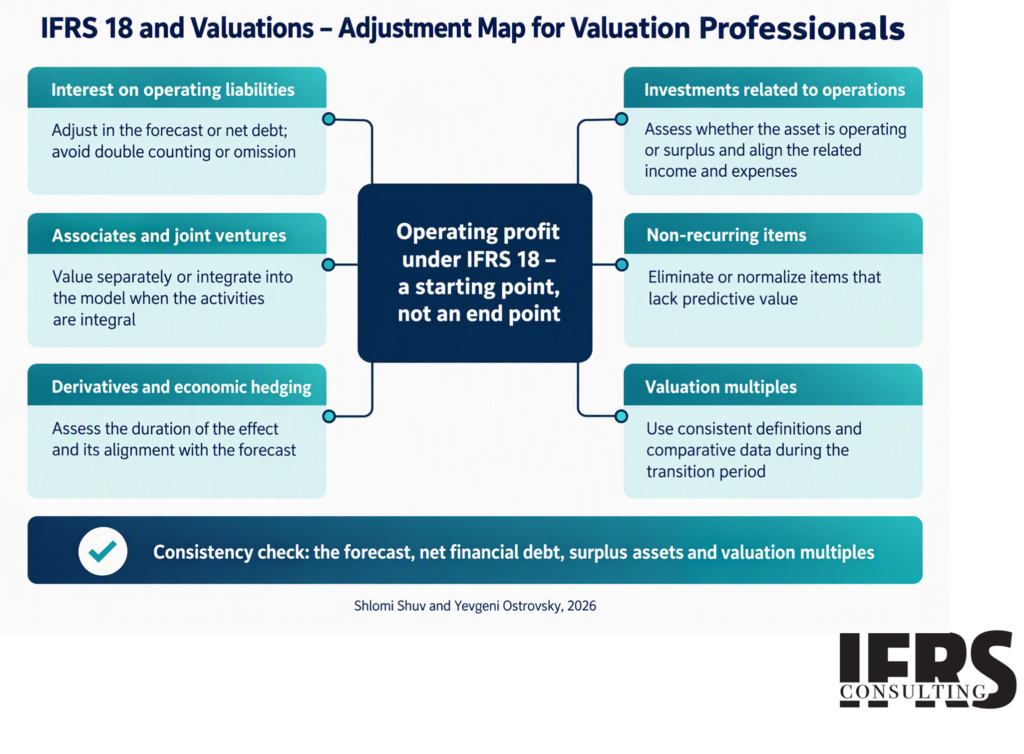
It appears that the prevailing corporate valuation model will be adjusted in light of the change in its starting point-operating profit—following the application of IFRS 18 at the beginning of 2027. Beyond the basic need to use consistent definitions and comparative data when calculating multiples (particularly during the transition period), the focus will be on the interface between accounting and economics: from identifying investments closely related to operations (including investments in associates) and normalizing items that lack predictive value, through adjusting the interest component of operating liabilities, to examining the duration of the effects of hedging transactions and aligning them with the long-term forecast.
 Background
At a theoretical level, the fair value of a company depends primarily on the forecast of its future free cash flow, plus the value of any surplus assets and liabilities that are not required for its operations, rather than on one accounting presentation or another. IFRS 18, which will become mandatorily effective from the financial statements for the first quarter of 2027 and replaces IAS 1, mainly addresses matters of financial statement presentation. Accordingly, at least in theory, it should not change the forecast of the company’s future cash flow.In practice, however, financial statements commonly serve as the starting point for forecasting a company’s future free cash flow. This raises the question of whether, and how, the changes expected under the Standard may affect the work of valuation professionals and, in particular, whether the Standard will bring the starting point for financial analysis-which, as noted, is based on the financial statements-closer to the forecast of future free cash flow. At the same time, where will differences between the accounting framework and the economic framework remain?
The core of the new Standard concerns the structure of the statement of profit or loss—an area that, despite being fundamental, has not previously been fully regulated in accounting. Accounting has not until now defined a company’s “operating profit”, nor has it required such a profit subtotal to be presented in profit or loss. The explanatory material to IAS 1 stated that, when operating profit is presented, it would be inappropriate to exclude from it items that are clearly operating in nature, such as depreciation, restructuring expenses or inventory impairment. Some companies currently do not present operating profit in their financial statements, while other companies that do present it include varying mixes of income and expenses. For example, practice is inconsistent as to whether operating profit includes an entity’s share of profits of associates and certain finance income and expenses, such as the unwinding of discount on employee-related liabilities or other provisions.
Structure of Profit or Loss under IFRS 18
The new Standard requires income and expenses to be classified into five categories, including three principal new categories: the operating, investing and financing categories. In addition, there are categories for income taxes and discontinued operations. As part of these requirements, an “operating profit” subtotal will be presented. Another significant change introduced by the Standard is the disclosure in the notes of alternative profit measures used by the company, referred to in the Standard as management-defined performance measures (MPMs). Examples may include FFO or adjusted EBITDA, which until now have generally been presented outside the financial statements, in reports accompanying the financial statements, such as directors’ or management reports, and in investor presentations. The Standard also includes enhanced guidance on the aggregation and disaggregation of information in the financial statements, which may further assist valuation professionals by improving transparency.
We have chosen to focus on “ordinary” operating companies—entities that, in the terminology of the Standard, do not invest in assets or provide financing to customers as a specified main business activity. In other words, our focus is not on entities such as banks, non-bank credit providers, insurance companies, investment property focused companies, holding companies (or investment entities), and similar entities. For entities of these kinds, both the starting point and the valuation technique may differ from those used for “ordinary” operating companies. In addition, for some of them the presentation of profit or loss under the Standard will differ and will include certain adjustments.
In summary, for “ordinary” companies, the investing category includes income and expenses from assets that generate a return individually and largely independently of the company’s other resources; income and expenses from investments in associates and joint ventures accounted for using the equity method; and returns from investing cash and cash equivalents. Examples of items included in this category are: (1) interest income from cash and cash equivalents, such as interest on current-account balances or short-term deposits; (2) interest income, foreign-exchange differences and credit losses-or, alternatively, fair value changes—on investments in bonds or other debt assets that generate a return independently; (3) dividend income and fair value changes on equity investments; (4) rental income, revaluation gains or losses, and gains or losses on disposal of investment property when investing in assets is not a main business activity of the company; (5) the company’s share of the profit or loss of an associate or joint venture accounted for using the equity method; and (6) gains or losses on disposal of stand-alone financial assets or other investments.
The financing category includes, first, all income and expenses arising from liabilities that result from transactions involving only the raising of finance-generally financial debt-and, second, interest expense and the effects of changes in interest rates on other liabilities arising from transactions that do not involve only the raising of finance. Examples of expenses relating to financial debt include: (1) interest expense on bank loans and bonds; (2) foreign-exchange differences on foreign-currency-denominated borrowings; (3) gains or losses arising from modifications, derecognition, changes in estimates of cash flows or fair value measurement; and (4) incremental transaction costs directly attributable to the issue or settlement of a financing liability. Other examples of expenses included in this category are: (1) the interest component of a lease liability; (2) the unwinding of the discount on a decommissioning or restoration provision, or another liability measured at present value; (3) net interest on a net defined benefit liability or asset; and (4) the interest component of a trade payable that contains a financing component.
In general, the operating category is defined in the Standard as a residual category. Operating profit therefore includes all income and expenses not classified by the Standard in another category. This classification approach may produce non-obvious outcomes because the list of circumstances in which income and expenses are classified in the other categories is not always sufficiently broad and is rule-based rather than principle-based. For example, ancillary costs relating to the management of investments that are not identified in the Standard, and are not costs of sale or purchase, must be classified in operating profit even if the investment returns are classified in the investing category. Thus, operating or maintenance costs of income-producing investment property held by a company whose business is not income-producing real estate would be included in operating profit, while rental income would generally be included in the investing category. Similarly, the costs of an investment management department would be included in operating profit, while investment returns would be included in the investing category. Operating profit may also absorb costs associated with financing, such as bank charges or fees for an undrawn credit facility, and will naturally include items of a non-recurring nature, such as a gain or loss on disposal of property, plant and equipment, business-combination transaction costs, or a bargain purchase gain.
Components of a Discounted Cash Flow Model for an Operating Company and Their Relationship to Financial Statements
In general, under a discounted cash flow model, the value of an operating enterprise is derived from the present value of the after-tax net operating cash flows that its operations are expected to generate, plus the value of the enterprise’s surplus assets and less its net financial debt.
Accordingly, in valuing the enterprise it is customary to prepare a forecast of free cash flow to the firm (FCFF) and discount it at a rate reflecting the weighted average cost of capital (WACC). Once enterprise value has been determined, adjustments are made for net financial debt, surplus assets and, in some cases, other components to derive equity value.
The operating cash flow forecast is often developed from financial statement data. The forecast generally starts with operating profit or EBITDA. Because operating profit was not clearly defined by accounting in the past, valuation professionals had some flexibility in defining it, provided that the valuation principles and consistency between the definition of operations and the other components were maintained. Operating tax and the adjustments from operating profit to cash flow are then derived—capital expenditure on property, plant and equipment and intangible assets, depreciation and amortisation, and the change in working capital. In this context, we assume that valuation professionals will use the Standard’s “new” operating profit as the starting point for developing their future forecasts on a similar basis.
The profit and operating cash flow forecast used for valuation purposes excludes the finance costs (interest) on the company’s financial debt and income from financial investments because the net financing component is reflected through the estimated discount rate (WACC), which also takes debt into account, and by deducting the value of the company’s net financial debt from the operating value of its business. Similarly, the forecast should not include the results of any surplus assets, such as investment property unrelated to the company’s operations, because their value is usually added separately to the enterprise value.
It is important to ensure that the interface between activities has been treated appropriately and that no items have been double counted in the valuation or, conversely, omitted entirely. For example, all costs that do not relate to financial debt and surplus assets must not be inadvertently eliminated from the operating forecast. Even before the Standard, this gave rise to challenges in areas such as the interest component of leases and costs relating to receivables factoring.
To illustrate, assume that a company routinely enters factoring transactions in which it sells-and derecognizes-trade receivable balances. No net financial debt is recognized in respect of those factoring transactions. At the same time, the company’s working capital appears more efficient, which may favorably affect its cash flow forecast, particularly under growth scenarios, because less investment in working capital is required. However, the cost of this more efficient working capital is the cost of factoring that results in derecognition. If the forecast change in operating working capital is based on balances affected by factoring activity, the operating forecast must also include the forecast costs of repeatedly executing such transactions. Current accounting requirements allow factoring transaction costs to be presented specifically within finance costs. Consequently, there was a risk that the valuation professional would not capture this effect unless deliberate adjustments were made to the operating margin for those finance costs.
In the factoring transaction described above, after application of the Standard, the costs of factoring transactions that result in derecognition of receivable balances will be classified in operating profit, rather than in the financing category in which some companies currently classify them. The basis used to forecast operating profit will therefore be more appropriate.
Effect on Valuation Multiples
A change in classification can alter reported operating profit without changing net profit, including for prior periods presented retrospectively on initial application of the Standard. As a result, the EV/EBIT multiple may change mechanically. EBITDA may also be affected indirectly, depending on the starting point and the items that the company-or a data provider such as Bloomberg-includes in its adjustments.
During the transition period, additional care will likely be required when comparing the multiple of a company that has applied IFRS 18 with a historical multiple or with a company reporting under the previous structure. Because the Standard is applied retrospectively and comparative amounts are required, a better basis for comparison is expected within the financial statements. However, databases, covenants and internal models may continue to use older definitions. This is somewhat reminiscent of the effect that the initial adoption of IFRS 16, which addresses leases, had on reported leverage.
Will the New Operating Profit Become the New Starting Point?
Probably yes. Operating profit under IFRS 18 has a clear advantage: it is an accounting-defined subtotal that is more uniform than in the past. Until now, companies and valuation professionals have used terms such as EBIT, profit from ordinary activities and adjusted operating profit, sometimes with different definitions. A mandatory subtotal may facilitate comparison. However, the term “operating profit” should not be attributed a broader economic meaning than that conveyed by its accounting definition. As described above, the operating category is a residual category; it is not a list of items developed through a structured assessment to ensure that they form part of core operating activities for valuation purposes. An item presented in the investing or financing categories may be closely related to the entity’s ability to operate, whereas a non-recurring item may be included in the operating category.
Accordingly, the new operating profit is indeed suitable-and it is reasonable to assume that it will become the conventional starting point-but it is not the end point for determining “economic” operating profit.
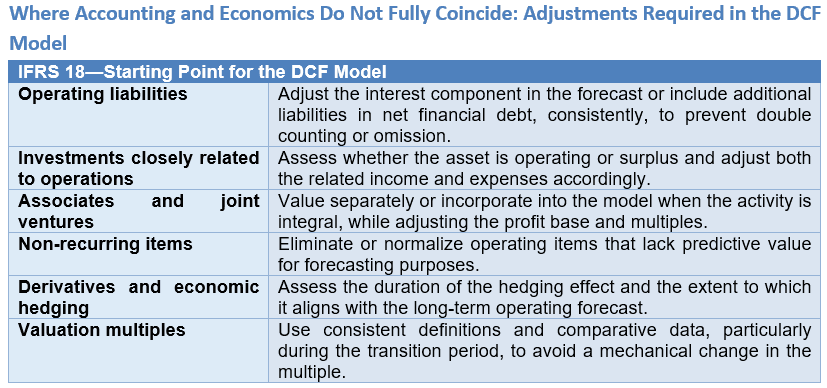
Key Adjustments Required to Operating Profit
1. Interest Component of Liabilities That Are Operating in Nature
As noted, the Standard requires the interest component of items that are not conventional financial debt instruments to be included in the financing category. Prominent examples are the interest component of a lease liability, the interest component embedded in the present value of provisions and decommissioning and restoration liabilities, and net interest on a defined benefit liability. Even today, two approaches may be applied in valuations with respect to leases. The first is the accounting approach. Under this approach, lease liabilities form part of the company’s financial debt, similarly to borrowings, while the operating forecast excludes the interest cost on that debt. The second approach does not treat lease liabilities as financial debt; consequently, it cannot disregard the interest-cost component embedded in leases and, in effect, treats lease payments in their entirety as operating expense components.
Following application of the Standard, this issue effectively expands to additional operating components, for example, employee benefit obligations, provisions and contingent liabilities, and interest-bearing trade payable balances. If the valuation professional elects to treat these items as part of the ongoing operating forecast, they will not be deducted from enterprise value as net financial debt, but the interest cost embedded in those liabilities will need to be reflected in the operating profit forecast. Under the Standard, however, that interest cost is not included in operating profit, and adjustments will therefore be required. The risk does not lie in choosing one approach or another, but in mixing approaches in a manner that creates double counting or, alternatively, an omission. In addition to interest, these components sometimes give rise to other expenses and income, including indexation, foreign-exchange differences, changes in estimates or current service cost, some of which will in any event be presented in the operating category. This may strengthen the tendency to use the operating approach and will require adjustment of the classification of interest expense between the structure of the statement of profit or loss and the starting point for the forecast.
2. Income and Expenses from Investments Closely Related to Operations
For a company that does not have investing in assets as a specified main business activity, income and expenses from assets that generate a return independently will be included in the investing category. This appears to establish a clear dividing line between operating activity and returns on cash balances and financial assets. In a DCF model, this separation is useful when cash is a surplus financial asset: interest income is excluded from the operating forecast, and the value of cash is added separately to enterprise value by including it—in practice, deducting it—in the calculation of the company’s “net” financial debt.
However, as with the previous requirements, not every cash balance or short-term deposit is necessarily surplus. Some businesses require a minimum level of cash for operations, settlement, cash registers, collateral or seasonal volatility. In such cases, some of the cash may be an operating asset and may even form part of working capital in the forecast change in working capital. In other cases, the requirement to hold deposits or investments may be regulatory or legal; for example, the treatment of controlled accounts used for real estate development projects held for sale. Questions arise as to whether certain investment income indirectly related to the company’s operations—such as investments required by regulation to operate in a particular industry—actually arises from investments that generate returns “individually and largely independently” of the company’s other resources. Depending on the approach adopted by different companies, valuation professionals may need to adjust here as well. The Standard contains a specific requirement on this matter for entities that provide financing to customers, and only in respect of cash and cash equivalents—not other investments—but does not address the matter more broadly. Thus, if a company includes income from an investment of a “regulatory” nature in investing rather than operating profit, a valuation professional may consider it appropriate to treat that profit as part of the operating forecast and the related assets as non-surplus assets. Whether financial and other assets are surplus—even when invested and interest-bearing throughout the forecast period—may affect the company’s value. For example, if an asset earns a risk-free rate but serves as regulatory collateral for a particular activity, it earns a return below the overall risk to which it is exposed. In the valuation, this erodes its value relative to a genuinely “free” financial asset because of the cost of capital.
Similarly, a manufacturing plant may hold a leased asset adjacent to its operating site; an infrastructure group may hold rights in an income-generating project connected with an infrastructure asset; and a company may lease out surplus floor space in an office building used as property, plant and equipment. At present, several questions arise concerning the classification of rental income from assets in circumstances such as these. It is clear, however, that if such income is not included in operating profit, the financial implication of using that operating profit is that the assets are surplus assets, and vice versa. For the time being, this matter is likely to require attention from valuation professionals.
An extreme case involving surplus assets may arise when the income from a particular surplus asset is included in the investing category but some of the related expenses are included in the operating category. A prominent example is investment property held by a company with other operating activities: its rental and revaluation income is presented in the investing category, while its operating expenses are presented in the operating category. If those expenses are material and the asset is treated as a surplus asset in the valuation, the expense base included in operating profit must also be adjusted before the forecast is prepared.
3. Investments in Associates and Joint Ventures
The Standard classifies income and expenses from investments accounted for using the equity method in the investing category, without further discretion. Here too, the classification creates a clear dividing line in the consolidated financial statements, but it may be less intuitive for companies in which an associate’s activities have a clear operating relationship with the business model, as may occur in the infrastructure or real estate sectors. One possible solution under the Standard may be to present an additional subtotal in profit or loss, after operating profit, comprising operating profit plus profit from associates. Another solution, which is also relevant before application of the Standard, is to present results on a proportionate-consolidation basis in the segment note or in other company publications directed to users of the financial statements.
The clean approach in valuations is generally to value the investment in the associate separately, based on its stand-alone value or by discounting dividends and cash flows available to the investor, and to add that value to the value of the principal operation. However, when the investee is essential or integral to the group’s operations, an integrated model may be required. If the associate forms part of the operating forecast—for example, a local branch of the company in a foreign country that operates with a local partner—an adjustment will clearly be required for the financial statement classification, which excludes the results from operating profit. An interesting point also arises in relation to the use of an operating profit multiple (EV/EBIT): if the multiple is calculated by reference to accounting operating profit, an immediate consequence is that operating profit excludes profits from associates even where their activities are integral.
4. Income and Expenses of a Non-Recurring Nature Included in Operating Profit
As is currently the case, the operating category will sometimes include items of a non-recurring nature. The Basis for Conclusions on the Standard states explicitly that the fact that an item of income or expense lacks predictive value, or is characterized by high volatility, does not mean that it is not an operating item.
Examples may include gains and impairment losses on property, plant and equipment, intangible assets or goodwill; the effects of provisions for class actions or exceptional claims; foreign-exchange differences relating to operating balances; and various effects of business combinations completed during the period, such as bargain purchase gains, transaction costs or remeasurement of contingent consideration. Naturally, as before application of the Standard, valuation professionals will need to continue assessing whether the company’s operating margins should be adjusted or normalized for items such as these, or others, when preparing valuation forecasts.
5. Derivatives Hedging Operating Exposures
Companies exposed to various risk factors—such as foreign-currency risks arising from transactions or commodity-price risks, for example the price of oil used in production—may hedge those risk factors using derivatives. Such derivatives are generally measured at fair value through profit or loss. When a company undertakes such hedging but does not apply hedge accounting, the question arises as to where changes in the derivatives’ fair value should be classified in profit or loss. Before application of the Standard, those changes may be presented within finance income or expenses or elsewhere in the statement, such as in operating profit when relevant. The Standard addresses this issue and generally requires derivatives that economically hedge a specified risk to be presented together with the risk they hedge. Accordingly, changes in the fair value of a derivative hedging the price of oil used in production will be presented in the operating category, whereas changes in the fair value of a derivative hedging the foreign-exchange risk of bonds issued by an operating entity will be presented in the financing category.
This treatment and the separation between the different categories clearly improve the relevance of operating profit compared with current practice, which may not reflect economic hedging activity. Nevertheless, after application of the Standard, valuation professionals will still need to exercise judgement as to the extent to which the effect of hedging activity on operating profit has long-term predictive value for the operating margin. The change in the derivative’s fair value—and therefore its effect on operating profit—may relate to the entire hedged volume, for example several quarters, rather than only to the quantity consumed or purchased by the company in a particular quarter. In addition, it is generally not possible to maintain a “permanent” economic hedge, and the effect of hedging on the operating margin may therefore diminish after a certain period. Some of these issues, however, also existed before application of the Standard.
(*) written by Shlomi Shuv and Yevgeni Ostrovsky