

While the inclusion of Management-Defined Performance Measures (MPMs) within the financial statements has received significant attention, IFRS 18 introduces another major change: a standardized income statement that groups items into operating, investing, and financing categories. This new structure changes how many income and expense items are classified and presented compared with current IFRS practice. Additionally, starting in 2027, the adoption of IFRS 18 is expected to increase the differences in reported operating profit and EBITDA between IFRS and US GAAP.
The new IFRS 18 introduces a uniform structure that classifies income statement line items into three main categories – operating, investing, and financing – thereby changing the classification and placement of numerous income and expense items relative to current practice. As a result, differences may, and indeed are expected to, arise in operating profit (and consequently in EBITDA) between companies reporting under IFRS and companies reporting under US GAAP. Paradoxically, given the general character of each accounting framework, application of the standard is expected to afford companies reporting under US GAAP greater reporting flexibility with respect to the presentation of results, owing to the absence of any mandatory categorization requirement and the greater flexibility permitted in presenting the income statement.
A further significant and conceptual gap arising from IFRS 18 stems from the fact that the standard introduces, for the first time, a formal and groundbreaking framework for Management-defined Performance Measures (MPMs), requiring disclosure in a dedicated note, together with a reconciliation to the nearest IFRS subtotal.
Ahead of the mandatory adoption at the beginning of 2027, and in order to highlight the principal differences, the table below maps the 12 main classification gaps arising from the implementation of IFRS 18 compared with US GAAP.
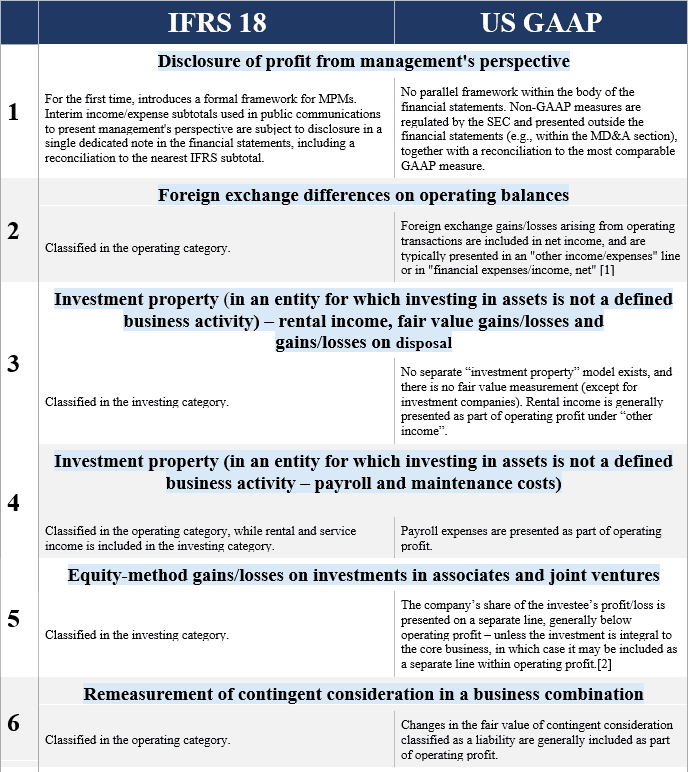
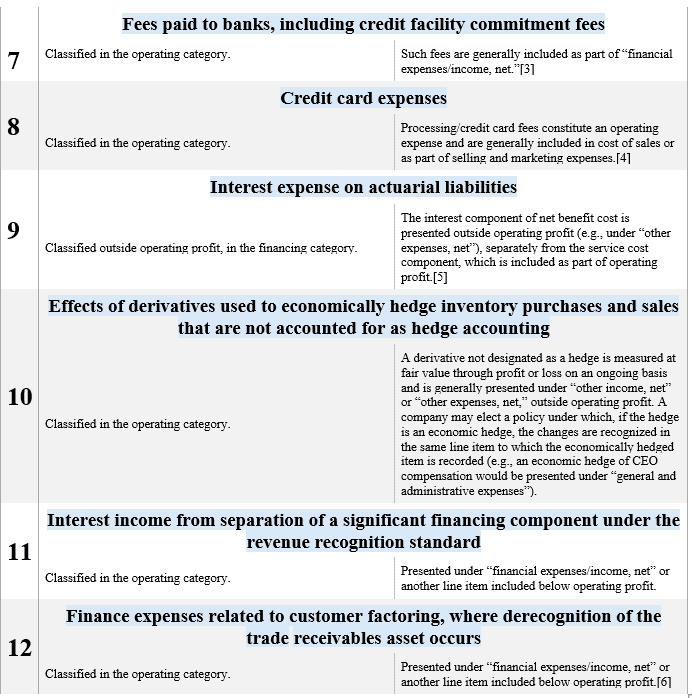
Ahead of mandatory adoption in 2027, the table below maps the 12 main classification gaps arising from the implementation of IFRS 18 compared with US GAAP. As with any new accounting standard, this is not a complete list. IFRS 18 may still have a few surprises waiting to be discovered.
[1] trade receivables/payables
[2] including those that form part of the core business activity
[3] where utilization is not expected
[4] processing fees
[5] employee benefits/pension
[6] in a company without a business activity of extending credit to customers
(*) This paper was co-authored by Shlomi Shuv and Eyal Ruff, Partner at the Professional Practice Department, EY